Contemporary Books: My Reviews of New Books and Novels

Updated: Jul 4
Hey there! I'm thrilled to bring you my review of some new books and novels. These recent publications are sure to spark your interest, that is if anyone reads anymore. Heads-up: my opinions are all my own, unlike those paid reviewers out there. If you want a stupid opinion, definitely read the NYT or WSJ. You are doubly stupid, first for paying to read the article and then second for believing it. And guess what? The White House is trying to hush up this list! The White House knows that if enough people know how to read, their plans will be subverted! That's why Donald is building the big new ball room -- to burn more books like Dr. Seuss and the other ones he knows how to read.
The way this blog works is I read a book in real life and then I blog about it on here. I keep adding more and more books to the blog over time, and you keep coming back to check periodically. You tell your friends if you read something interesting and you forward the blog to them. I will also attempt to compare recent novels and authors to each other, when possible for my tiny brain.
Why did I write "books and novels"? I did that because for me "books" sort of refers more to non-fiction and other possibilities, whereas novels are novels of course, and always are fiction.
Each book I rate on a scale of zero to four stars.
Wow!!!!!! On today July 4 I'm coming at you with some new non-fiction.

The Gales of November, non-fiction by John U. Bacon, published 2025, Four Stars *****
This is about as fresh as it comes for non-fiction. Just published last year I've already read it this year! Who can believe it! Nobody!
Truth be told, when I read non-fiction about ships or military I usually think of my dad because these types of non-fiction were favorites of his. After being active in the Navy for four years, he was familiar with the duties and protocols of ships and had a better than regular understanding of life on a ship.
So Gales of November is a specific boat or ship book about the wreck of the Edmund Fitzgerald, which was a big ship that moved cargo on the Great Lakes in the 1970's.
The book is well written, concise and interesting with a good combination of stories and analogies mixed with facts and data. The author seems to have a legitimate passion for the topic at hand, that is, this ship but also Great Lakes shipping in general.
The book sets the scene with a history of Great Lakes shipping especially in the earlier part of the 20th century. Most of us not from that part of the world don't understand or appreciate the great amount of commerce and goods floating through the Great Lakes. In fact if you go back to the 1940's or 1950's or 60's, you would quickly find cities like Detroit and Toledo to be humongous areas of money and power and commerce. So much so that the elite coastal cities NY and LA would not have been cities people worried about having too much power or influence back then. All the money was in the cars and steel and other industries around the Great Lakes area.
Of course the shipping industry had incentives to move more cargo and faster and over the decades they did all these things at times pushing safety boundaries to make more money for their clients and companies. Prior to the wreck of the Edmund Fitzgerald a few major wrecks occurred that could have caused the shipping industry to take notice and slow down.
But the Edmund Fitzgerald pushed on, always bigger and better. Of course that's the rest of the story, how a terrible storm would sink this ship.
The wrest of the book talks about the survivors and all they did to hold strong, and there's a nice tribute to the Gordon Lightfoot song and what it meant to him.
I think anyone female or male age 12 or older could enjoy this. No negative content in my opinion.

The Lost Empire of Emanuel Nobel, by Douglas Brunt, published 2026, 3 stars
Holy cow my people, so fresh, this was published just earlier this year (April or May) and I've read and reviewed it already. What??? The non-fiction here is so fresh.
I read fiction, I read non-fiction, I love both, both are beautiful and support each other.
Wow I loved the content in this book. I was so surprised by the number of events and activities of which I had not been aware. It really surprised me to learn about the world of Emanuel Nobel in Russia. Totally crazy. I had no idea. This is what I love about non-fiction -- finding new adventures, new stories. Non-fiction also grounds me in reality -- for a lot of these cats in history their lives were hard, long, unpredictable. So often they had great suffering and terrible luck. A reminder that's how life is for all of us, including me every day.
The writing here is a bit clumsy for me, especially in the first part of the book. It felt like at times the author didn't have as many resources or citations as he wanted, so he was trying to write without enough information. This is my opinion.
Essentially this book tells the story of how Emanuel Nobel (part of the famous Swedish Nobel family) was a major influence in beginning the petroleum industry in Russia. For many decades this was a corporate or capitalist enterprise with Nobel learning how to manage a company, how to sell oil, where to find oil, and how to manage political relationships in Russia.
Over time the story becomes more political as 1917 approaches and different groups in power whether the aristocracy or the 1917 revolutionaries know they need oil for military might.
I very much enjoyed the Russian history element both up to and after 1917, enjoyed reading about the Communist revolution, and mainly the story of Nobel beginning this petroleum industry.
Recommend for anyone age 12 and older. For me no negative content here.

Empire of AI, non-fiction by Karen Hao, published 2025. Three stars.
So this is not really pulp fiction or super fun to read or anything, it reads more like a college book in my opinion. The author, an experienced tech and AI reporter, goes inside Open AI and some of its partner companies to tell us how Open AI was formed, who its players are, and what it wants to accomplish.
The first half of this book is a big back story on the major cats involved in AI, including Sam Altman. It was somewhat interesting to me but not overly so, as the story seems to be written more for an insider crowd. As the book continues and we learn about Open AI's competition and challenges, the book gets more interesting to me, especially when we get to the real nuts and bolts about how much land and water and energy these companies need to train their AI.
I ended up with a better and clearer understanding than before of what different AI companies are doing and how they see the future. Not being an insider or a computer guy myself, I didn't achieve max understanding but I did enjoy the book overall.
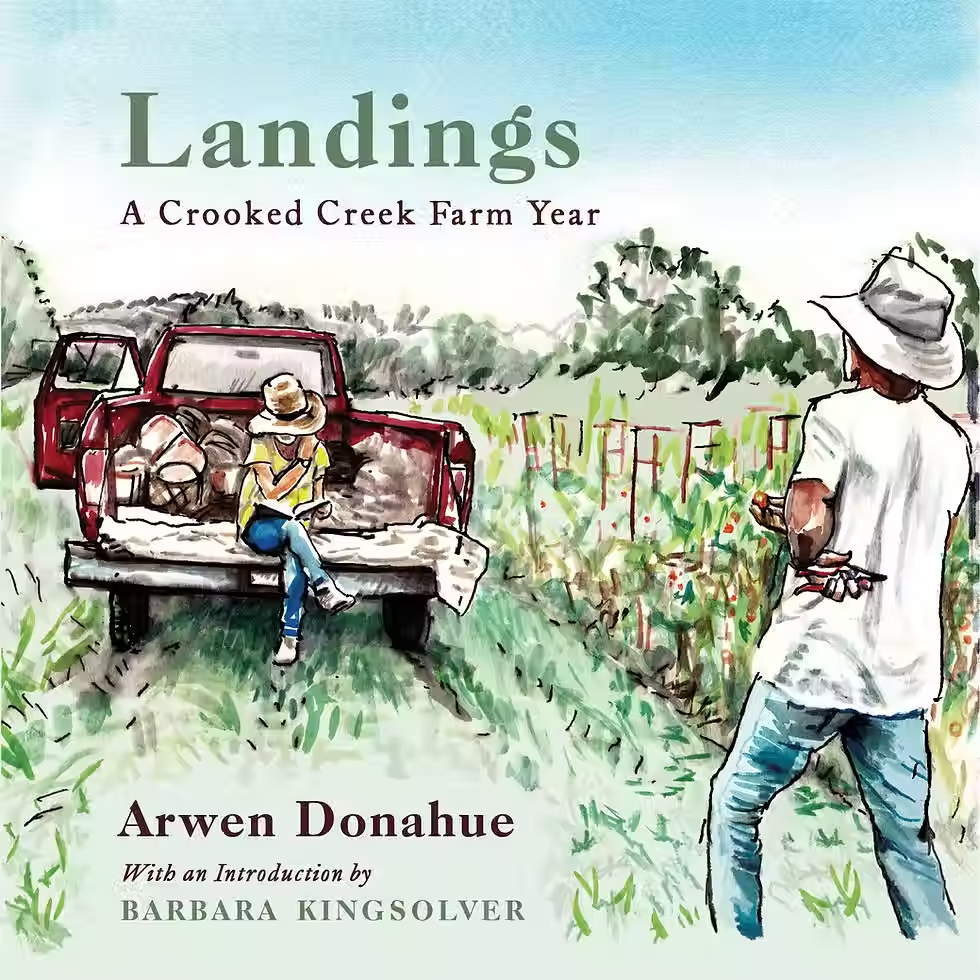
Landings: A Crooked Creek Farm Year, by Arwen Donahue, published 2022, four stars. Four big stars!
Landings is a hybrid book of memoir or autobiography and art/sketches by author Arwen Donahue. I found this because around the time her novel Demon Copperhead was blowing up, Barbara Kingsolver mentioned this as a book she thought others should read.
Donahue and her husband and daughter are farmers in Kentucky, Appalachia. They run a family farm without huge modern equipment and without tons of help, or without any help perhaps. They primarily sell produce and other goods (eggs?) through co-op arrangements, never being far from being in debt and losing everything.
Each page allows Arwen to chronicle "a day in a year" of their lives, whether fixing fence, taking a goat to market, or similar.
The idea of the book, I believe, is the difficulty of living an authentic farming life like this -- to actually grow what you eat and to minimize the exploitation of others including animals. The book is a pleasure to read and consider because the family has achieved a sort of peace that would be impossible to replicate -- a knowledge that they can sustain themselves for a long time, setting aside healthcare of course. On the other hand it's heartbreaking to read because they are back in hunter-gatherer times -- they can never stop! They can never rest! There is no money in the bank, the storehouse is never full! They have no modern access to healthcare!
How crazy is it in this country that you could work 80 or 100 or 120 hours in a week to raise crops and animals and yet if you have a problem needing an MRI or a certain lab test, that might put you out of business for the year??????? What a country!!!!!!!!!!!

Upgrade, by Blake Crouch, published 2022, 3.0 stars.
Let's break it down people. This is not just a list of books I've read recently and my comments on them. Let's break it down, let's be honest, let's confess our weaknesses to each other.
Sometimes you have to keep reading no matter what, because it keeps you alive, it keeps you going, it keeps your brain running. Reading is similar to eating or sleeping, it's something you need to do every day, just to keep the motor running. Reading sparks imagination, it gives you a private safe place to relax. Reading activates your brain to spell words, to speak phrases, to arrange ideas and symbols together for the purpose of communication. Reading is vital to daily sanity and health.
I've said this before but when I woke up in the hospital in summer of 2023 after my brain tumor surgery, a friend Kelley from work brought me a sack of books. It saved my life, it changed my life. During the six months I was at home after my surgery, limited in what I could do and where I could go, I was not at all limited in how much I could read or what types of books I read. Reading reminded me I was normal and could keep learning, have fun, and go anywhere I wanted.
Sometimes I start something and look I'm not smart enough to keep going, or I feel like I am missing some basic context or skill set to plow through. In that case I just put down the book.
This happened to me recently with The Land, by Maggie O'Farrell. I just couldn't get through it, I don't know what it was. I had to abandon it. I felt l was in a swamp.
I started and abandoned two other books. It felt like I wasn't smart enough to read them.
In this situation, I decided to read something easy that would get me reading again, so I picked up another Blake Crouch novel, Upgrade this time.
This is my third Crouch novel, having read Recursion and Dark Matter. Dark Matter is the best so far but Upgrade is close to it, and Recursion is not a good book.
The premise of Upgrade is that biotech has been unleashed on the world that will cause humans to "upgrade" and to become superior versions of themselves, bigger faster stronger smarter, and so on.
The book raises interesting questions such as whether we would voluntarily take an upgrade, and in what ways. The book also invites us to think about our strengths and weaknesses -- perhaps the things we are weak at are most important to our character, self-identity and development. Perhaps being upgraded and being "better" at athletics or music or art or our job, or whatever, would interfere with our actual best interest.
Maybe being vulnerable and weak and sick and helpless and dependent is more important to progress than being strong and smart.
So I enjoyed thinking about these questions all the while following the actual plot of the book.

I Have Some Questions for You, a novel by Rebecca Makkai, 3 stars, published 2023.
After reading The Great Believers by this same author, I decided to stay with this author and read another one of her novels. As you can see below, I loved The Great Believers.
In I Have Some Questions for You, Makkai writes a totally different sort of novel, a novel about a film professor who returns to her boarding school in an attempt to solve a crime that occurred when she was attending boarding school. The main storyline/plot is a modern story about solving a crime, with a minor subplot related to different characters revisiting their boarding school days and finding some closure or solace there.
When I read a novel like this I am expecting the author to provide something unique and new. There is so much true crime and crime-related story on TV and in novels, I'm not going to be in awe of the author for simply writing a standard modern crime novel.
In this case I award three stars to the book because the author keeps me engaged throughout, especially in the end portions of the book where she unveils a few surprises that kept me surprised and interested.
I'm not in love with the main character and don't really understand why so many modern characters read like this.
Worth reading but nothing special.
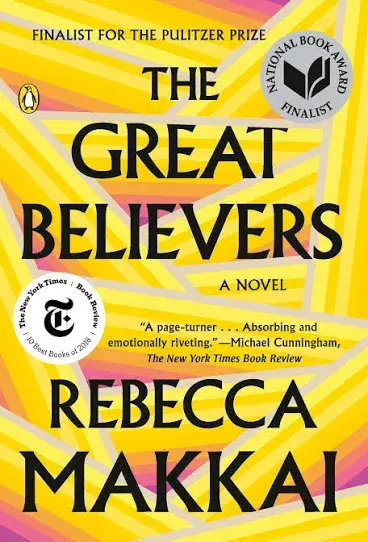
The Great Believers, a novel by Rebecca Makkai, published 2018. Four stars!!!! Four big stars!!!!!
This is what great literature is all about, this is how authors make their names famous and make readers all over the globe smile and cry and clap. Wonderful wonderful novel. Everyone should read this in any language.
The book is a third party narrative told in two parts, where the stories overlap and connect. In thd 1980's there is a group of gay men in Chicago facing the AIDS crisis. Each character knows someone who has died or will die of AIDS, many of the characters themselves facing the disease directly. One of these men in the 80's is Yale Tishman, a development officer at or near Northwestern who is handling a gift donation of several paintings of famous artists. The second part of the story occurs in Paris in 2015 and 2016 and centers around a different character Fiona, a sister of one of Yale's friends who died of AIDS. She is in Paris to reconnect with her adult daughter who is not overly interested in seeing her.
The story explores of course the AIDS crisis, studies how relationships were impacted by the crisis, looks at fears men faced of getting sick or dying, how they coped with their situations, and in many cases what medical care was or was not available. There is some political exploration regarding the politics of AIDS in America.
The novel features many well-drawn, deep characters, women and men, young and old, who are involved either in the crisis in Chicago or in the Chicago art scene as discussed in the story. So many wonderful, real characters with hope and brains who often suffer. It's a story of tremendous love and courage that features both Chicago and Paris and provides interesting historical context re: both AIDS and some of the painters of the early 20th century in Paris.
A huge bravo to his author and this novel.

Recursion, by Blake Crouch. Published 2019. 1/2 star.
Before we get into this book specifically, let's talk about what the author's job is, or what we can reasonably expect when we buy a book or buy an audiobook.
Sometimes we simply expect some form of entertainment but of course we want more than that, too. We want the author to tell a story, something with a beginning and a middle and an end, a story where we find ourselves rooting for and against certain people. We root for them or against them because we feel we understand them -- the characters have credibility. Even if we don't know that person in real life, the character in the story seems realistic, like someone who could exist in real life. We understand what makes them tic and we believe they are really made up like that. In the story various factors like fate or other people or the economy or various powers come to either support the main character or to deny the main character what she wants. The main character sort of fights with or against the other characters who can help or hinder her.
We also expect the author to use language or dialogue in a meaningful way or even a novel way. We want to see a new world or an old world in new ways through the author. We want the conversations to be realistic but we also want them to be somehow different than every other conversation we've ever read. We want the story and the people and their language to be credible.
We want to feel like the novel was "worth it." The author took us seriously as readers, they treated us like intelligent people who didn't have an infinite amount of time or money.
Having said all of this, Recursion is surely one of the worst novels ever written. The premise of the book involves FMS or False Memory Syndrome, a disease in which certain patients or people believe they have real or fact-based memories when in fact the memories are false or not real.
In this book, the author creates sort of a sci-fi police or detective novel in which several characters Slade, Helena and Barry create or utilize a "chair" which is a medical or scientific machine that is built to install memories into dementia patients. Having created the chair, all hell then breaks loose because using the chair, all the characters can essentially time travel infinitely. By the time you get to the end of the book, the world has ended a billion times, just kidding, because any character can go back in time to just before dying only to die again.
As you can imagine, the plot becomes infinitely stupid, like Trump and Putin both punching each other in the face forever while the rest of us have to watch. Slade (the bad guy) goes back in time to wreck everything and then Helena goes back to save the day and then Slade goes back further to ruin it and then here comes Barry to go back even farther. It's incredibly stupid.
Along the way Barry and Helena manage to fall in love 18,000 times and break up and die and meet again as they are constantly going back and forth in time. So stupid.
In short, the author treats the readers like idiots, the author takes a giant shit on our heads as we read his stupid book.
This book gets 1/2 star because you can use the paper from the book in a backyard fire.

The Demon of Unrest, non-fiction by Erik Larson, published 2024. 2 stars.
Many of you have probably read Devil in the White City, Erik Larson's best book so far, which I strongly recommend. Devil goes back and forth between a world fair in Chicago and the architectural delights of Chicago contrasted with a brutal murderer living in Chicago. It's an amazing book because Larson achieves the blood-curling and sinister work of a murderer while also portraying magnificently the work of many architects who have blessed the Chicago skyline over the decades. If I were reviewing Devil here it would get four stars.
Larson also wrote The Splendid and the Vile, non-fiction about Winston Churchill, which is a good book but a step below Devil.
Here, Larson tackles the beginning of the Civil War, with the events leading up to the destruction of Fort Sumter. Larson opens with a brave opening in which he claims he wants to portray the beginning of the Civil War like a murder mystery. There's nothing "wrong" with his writing. It's historically accurate and has the proper pacing and gravitas. For me, however, the beginning of the Civil War is too slow a topic for Larson to find success with me. Maybe I've read about the Civil War too many times already. I just finished a couple of books about Grant that were page turners. I guess my Civil War tank is currently empty.

The Marriage Portrait, by Maggie O'Farrell, published 2022. 3. 5 Stars.
I really enjoyed reading this and thinking about it. Here the author focuses on the marriage of an Italian count to his very young wife. The whole story is focused on their marriage, through her point of view. The "marriage portrait" is designed as a way to understand all aristocrat marriages in France and Italy and other western European countries at the time. The novel also puts into perspective the differing roles of and power of men and women over the same period in history.
We know that current readers are really interested in aristocrats in former times. Like "reality tv" we love reading about rich people and their problems. Here the author describes very well the privileges of the rich in terms of the textiles and colors they can afford, the privacy they can afford, the foods and drinks. Something as simple as getting from point A to point B without getting mud on your feed is well described here.
Maggie O'Farrell's strength here is defining the inner energy, strength, and personality of the duchess. She is here to remind us of all other similarly situated women but we also see a well-defined individual who maintains her own identity despite court life and despite her husband's power and inability to fully see her.
O'Farrell shows us many moments when the duchess defies her husband in ways that are kind and generous to others but in ways that do not lead to her being punished or killed. It's a very clever way that the author uses to show us the personality of the main character.
I could see the hallways and courtyards the author was depicting, taste the foods, smell the smells, feel the fear. She does an excellent job painting these characters just as the story revolves around the duchess herself being painted.
This would be an excellent book club book because it could yield discussions around gender roles as they change through history and the tension between obedience and kindness.
It's a beautiful book and I enjoyed reading it and thinking about it.

Dark Matter, by Blake Crouch, published 2016. Four stars.
This novel is a tremendous achievement and is now a television series on Apple. More importantly I'm excited to find that I love this author and now I see he has written many more books I can now enjoy.
Dark Matter is a mind-bender, sci-fi story that reminds me in some ways of Breaking Bad the television show mixed with sci-fi like Black Mirror.
Here the premise is that a scientist has created technology that can be used to travel to other parallel realities. The book posits there are infinite universes parallel to this one where each new universe is similar to the prior one except that the new universe is created each time a person makes a major decision.
For example universe A is this one but universe B is created when I attend graduate school in Colorado in universe A and in universe B a new world goes on where I'm in Florida or similar in graduate school.
Anyway the scientist creates the ability to travel between these worlds bringing chaos into all the universes because now there are infinite scientists aware of the new technology and they are all traveling around trying to kill each other.
The story is told from the POV of the main scientist who is married to an artist, and they have a child. Even though the premise is mind bending and infinite in scope the author does a great job simplifying it so we can understand the idea and get through the reading.
Similarly the author does a fantastic job bringing the story to a close. With a complex plot like this I almost wondered how the author could possibly end this, but I found the ending satisfying
For me I don't find the main character very interesting. He's basically your regular asshole scientist -- every university in America has thousands of these. But of course this person is necessary to the plot. The relationship or love between the main character Jason and his wife is super thin and lame and the author really writes like a third grader here.
Nonetheless I had so much fun following the plot here and imagining the impact in real life, it turned into a super page turner for me and I finished in one day.
Yesteryear, by Caro Claire Burke, published 2026. Zero stars.
I don't know why this book was written, I don't know why this book was published. I kept waiting for it to get interesting, I kept waiting for there to be a reason I read the book. That never happened.
As you know by now the premise of the book is mocking trad-wife influencing such as you might see in Utah on Ballerina Farms. The book is a cheap take-down, I'd be surprised if the novel took more than ten or twenty hours to write. It's an off-the-cuff story told without organization or the normal elements of good writing such as character development.
In this story we are never given a reason to care about the narrator. Thus we cannot dislike her either, because she is never portrayed as a person with dimension. She is put into position at first in the story only to be criticized later.
The character and the story are incoherent and inconsistent. Here she's inadvertently involved in MAGA, here she cares for her children, here she interacts with her mother. The plot elements are designed very thinly and don't add up.
If you want to have a laugh at the expense of social media influencers, you are better off to get together with a friend and make fun of reality TV as you watch it. This book is trash.

Isola, by Allegra Goodman, 3.5 stars. Published 2025.
This is a great book that everyone should read, men, women, porpoises, and so on. Historical fiction. The story is based on a real-life woman who lived in France in the 1500's and who was marooned in New France (Canada) with a husband she met aboard a ship. It's a powerful story of self-determination and survival, as she must bury her husband, baby, and maid on this lonely tiny island in Canada, to say nothing of surviving there in a shelter for several years. Most importantly she outwits her guardian who puts her in this situation. I enjoyed the historical settings including the land and the ship.
As someone who has been facing cancer for three years now, I found strength and purpose in reading this. The characters are fictional obviously but they are sketched so carefully that I found myself being able to rely on them and draw real strength from them. I have not read this author before but I am interested now in seeking out her other work.

Signs: the Secret Language of the Universe, published 2019, by Laura Lynne Jackson, 2.5 stars.
I enjoyed the content and found myself open to it. The content inspired me to try to keep open more the lines of communication between this world and the world of the deceased. I like the idea of "asking" the dead to make a sign or a pattern of signs to indicate they are paying attention. I believe this can happen, that it is factual. I tried some of the exercises and found myself more open to feeling the spirit of my dad, or mom, for example. I believe the writer is telling the truth and that she has this real skill. Ultimately the author and the publisher/editor kind of mail it in here. She has some real insights for the first half of the book or so and then after that she sort of repeats what we already know about prayer, health, sleep, meditation, and so on. I wish she had pushed harder to describe how she feels this contact with the dead, and other aspects of her skill or gift. It's a good book to read and discuss but ultimately there's not enough real writing there for me to push it to four stars.

In the Country of Men, by Hisham Matar, published 2006, 3.5 stars.
I loved reading The Return by Hisham Matar so I followed it up with this prior novel by the same author. This one reminds me a lot of La Promesse de L'Aube by Romain Gary (The Promise of Dawn), a French novel in which the narrator, a writer, has a very strong mother figure, just as is true here. Here the narrator is a young boy in Libya who observes the world all around him, first and foremost his mother who drinks to excess and smothers him with both love and neglect. The boy observes also the exterior world of politics in which his father is engaged. This feels a lot to me like a lot of the famous French novels in the early 19th century, such as those by Gide and Camus. The writing is simple and poetic.
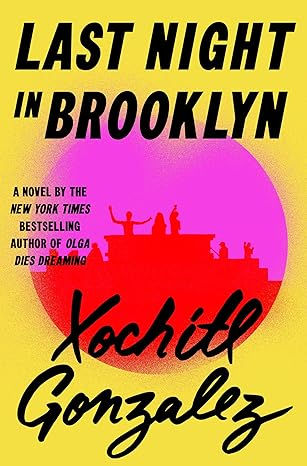
Last Night in Brooklyn, by Xochitl Gonzalez, published 2026, 3.5 stars.
Wow, so fresh, this was just published last month in April 2026. Read it while it's hot, still hot off the press! This is a short novel (200 pages) that sounds biographical or like a memoir but isn't -- it's set in Brooklyn of course and the story purports to be the narrator and her group of friends in Brooklyn having sort of a last party a last set of parties as their lives all change in different ways, never to be the same again. Super lyrical like a long poem, colorful language, the language of New York and Brooklyn, meant to sound like the real people. It's a book exploring themes of race and privilege, money and class. I would read it not for its plot but for its overall energy and vibe and it gives a legitimate feeling of being with and among these Brooklyn-ites. I really enjoyed reading this.

The Return, a Memoir by Hisham Matar, published 2016. 4 stars, 4 big stars!!!!!!!!!!!!!!!
Beautiful beautiful book, so much sacrifice went into this and you can feel it. Hisham Matar, a Libyan-English writer, travels back to Libya in 2012 to try to discover the fate of his father who was a political dissident in Libya. The book deals with memory and loss, revisiting difficult and traumatic moments and scraping over them again and again to find missing details, to find perhaps solace or even little scraps of fact or truth that were misplaced earlier. It is difficult for me to understand the courage of those who intentionally defy powerful dictators and then are punished for it, and sometimes killed. It is difficult for me to understand that level of strength, endurance, and conviction. It's moving to see in action. Matar paints the territory beautifully, presenting pain and memory and hope as a song moved about in the wind.

Project Hail Mary, by Andy Weir, published 2021. Four out of four stars.
My wife listened to this one on audiobook several years ago, then I saw the film, then I read the book. So I've heard the story now three different times. I'm not the ideal target for this type of novel. I don't love sci-fi generally, and in general I really dislike science types who like to boss everyone around like a bunch of Germans. But the degree of difficulty of creating an adventure of this magnitude, with only three real stars (narrator, the science leader, Rocky), is extremely high, and keeping us engaged for a long period of time while our hero is in a pretty tiny space with little to do, is even more difficult. You could say that writing this book was as hard as it was for Tom Hanks to keep our attention in Castaway without any help from other characters.
I don't really care about science and I don't care if the ideas the author made up are doable or tangible or mathematically correct, but it was enough (more than enough) for me to believe that all of earth was in danger unless this mission was successful. And even though I was never going to invest in the math or science here, it made perfect sense to me what the author was describing as far as this new dangerous molecule or element eating our sun and thus putting earth at risk. Obviously the idea of being in flight for 26 years to save the earth was a monumental undertaking that gave us a huge sense of stakes and loneliness for Grace. I was amazed the author could create such a viable alien Rocky to fit into the plot with Grace.
I wish the author could have used Grace to go a bit deeper -- after being alone for that long it seems like you'd have some crazy or interesting ideas, but the author sort of uses Grace has a straight arrow scientist who doesn't get too emotional about things.
Hats off to Andy Weir for creating both this and the Martian. That's tough to do -- create such new and big and powerful stories that so many people like.

Happiness Falls, by Angie Kim, three stars. Published 2023.
I bought his upon the recommendation of a bookseller in Savannah, Georgia. It's a bit hard to characterize this story. It's a novel of course told by the female Asian daughter in a family. The brother Eugene, has autism with difficulty speaking. When the father of the family goes missing while spending time with Eugene outside, the police suspect Eugene. Because the boy Eugene is not verbal, it's quite difficult for the police to piece together what might have happened. The search for the dad is further obscured by police racism and stupidity.
So the novel is maybe a detective novel or police novel of sorts, while also telling us about the challenge of a family with a disabled son who is also Korean. There are a lot of family dynamics here between the narrator, her brother John, the brother Eugene, the mom, and the dad.
I didn't find the police investigation interesting or realistic but I did appreciate the author's insights into the challenges of this disability and the artificial walls of bias whether towards disability or skin color. The author went to amazing amount of work to create this mystery and I imagine her outlines must have been detailed and massive, but that part of the story didn't pay off with me entirely.

Atmosphere, by Taylor Jenkins Reid, Published 2025. Three out of four stars.
Finished this one this morning, Saturday morning, sweet sweet Saturday. This was a novel where the ending was so surprising and good that it raised the overall read from 2.5 stars to 3 stars. It's a fun book with a lot of perspectives, though at times it drifts into sentimentality for reasons that aren't clear and don't help the overall story.
Atmosphere is a love story of historical fiction set in the 1980's NASA program. Several men and women are in a training program in which some will be selected to fly a shuttle to space. I enjoyed learning more about the space program and the night sky from main character Joan Goodwin, who has loved the stars her whole life. Joan brought me into the story especially in the beginning with her love of the stars and her ability to explain them to the reader. Her character is well drawn from the start. Joan meets Vanessa, a pilot trying out for the space program. Joan and Vanessa fall in love, although they have to be careful because they fear that open lesbian activity may lead to punishment from the space program. Meanwhile Joan tends her niece Frances with whom she shares a close relationship, although Joan's sister Barbara (Frances' mother) is always bossing Joan around and criticizing Joan's lifestyle.
The novel goes back and forth between Joan and Vanessa's love story and a NASA flight occurring in current time where Vanessa is the pilot and Joan is the voice for NASA. We are also met with various flashbacks that catch us up to how we got here as well as tension between Frances and her mom.
I liked the first part of the love story, watching Joan realize she had feelings for Vanessa and watching her act on those feelings finally. I enjoyed observing their mutual support for each other and loyalty. However, the part of the story where Vanessa and Frances intersect did not seem terribly realistic to me. The speed at which Vanessa became Frances' second cool aunt was not realistic whatsoever and avoided the real life challenges involved in sharing children in a relationship. I also felt like Barbara and Frances were exaggerated characters and not people I have met in real life. These exaggerated characters together with the silly dialogue at times made it impossible for me to give this novel four stars. Nonetheless I enjoyed most of the love story with Vanessa and Joan and enjoyed learning more about flight and the stars.

Tomorrow and Tomorrow and Tomorrow, by Gabrielle Zevin. Published 2022. Four stars. Four big stars!!!
Wow, I just finished this one. This was a hard novel to finish in the sense that I didn't want it to end because I feared I would miss the characters once I was done. It was painful to finish both because now I miss it and because there are a lot of things that happen to the characters towards the end that are painful for them.
This is a novel covering events of the past 20 years, told in the third person, with narrative focus shifting primarily between two main characters Sam and Sadie, but also another main character Marx. These three characters and their friends are all computer game designers and the book explores their relationships and friendships as they make a company together. It's a modern book in that it helped me understand why so many people are addicted to games including participating so much in pretend worlds. The author goes deep inside the heads of those who make games and how they see the world and how they are able to use their strengths to make games and money. We also see how these qualities play out in their relationships and create limitations in many regards, for example the demands on their time are great, and they struggle in relationships when creativity is shared in some ways.
In the games everyone dies and the game can be reset but not so in real life. These characters all face real problems and real pain and I cried several times while reading the book. One main character struggles with a disability that limits his movement and comfort but more importantly makes people perceive him differently, which fuels him in myriad ways both good and bad. Two main characters struggle with depression which is painful to witness particularly as they hurt themselves and each other as these diseases drag on. Another side character faces cancer.
It's not a central conceit of the book but the story does explore how in real life we don't get a total reset but the author does grant grace to the main characters as they get several "tries" or "chances" in life that feel like renewal or trying again, even though they don't get a clean refresh as in a video game. The author shows how the real-life people put their experiences into their games and how the best games are those most influenced by the real-life experiences of the creators.
I was touched by the feeling of energy of being in college and finding friends in your own tribe, and burning the midnight oil, and I was hurt to see these people at times hurt each other in ways that I didn't completely understand and couldn't empathize with, because these actions did not seem realistic to me at times.
I would note that I recently read also The Overstory by Richard Powers as well as Playground by Richard Powers. In all three of these books, the nature of game design, game play, and AI are discussed. Each author makes commentary on how the real world shapes the pretend world of games and also how the pretend world of games also shapes the real world. Each author grapples with AI to some degree. I'm not sure either author answers all the questions about AI but both admire its power and speed and all the books give a sense of how powerful and potent the technology is. It's fun to see AI tackled in contemporary books.
I highly recommend this novel to anyone age 10 (if mature reader) or above.

The Overstory, by Richard Powers. Four stars. Published 2018, won the Pulitzer Prize the following year.
Look, Powers is one of America's best and most prolific authors. Read this and then read Playground, and you'll be addicted to his writing.
The Overstory and Playground have some similarities and some differences. You should read both. The Overstory is a narrative about a number of super interesting American characters. There are at least nine main storylines that interweave more and more as the story progresses. Each character and each storyline relates in some significant way to trees, and so the story itself becomes to be more about trees than humans, and the trees impact humans in myriad ways just as the humans impact trees in myriad ways.
One of my favorite characters is Ma Sih Hsuin aka Winston Ma. He is the father of Mimi Ma, also a main character. Winston is pushed by his own father in China to emigrate to America at a time when the Communist Chinese are expelling the Muslim Chinese. He brings with him certain valuable family heirlooms, which he gives to his daughters.
One of the beauties of this character is that he is Chinese but learns English from a tutor in China, so he does not have a natural American accent. He marries an American woman and their three daughters learn English in the schools, but in some ways still maintain some of the language quirks and cultural quirks of their own father. It's brilliant how the author shows the interweaving of the American and Chinese cultures together over generations of time, reminding us of course of trees and how they impact humans and each other.
Using Winston as a main character is a brilliant way to show the themes of immigration, foreigners in America, and the various conflicts and challenges presented by being "non-white" in America throughout many decades. The author is not preachy or judgmental, similar to showing how trees grow in a forest, he simply shows what becomes of different people as they interact with each other over time. The author seems to be saying: "look at the inevitable bounty and beauty of diversity when brought together over time, look at the curiosity and strength created and expanded by different cultures mixing together."
Below I use AI to make an image of what I imagine Winston to look like as I read the book.

Over the course of the novel, some characters study trees and tree seeds and become academics with respect to trees and their benefits to the earth. Some characters become environmental activists and fight to preserve trees. Some characters have artistic explorations involving trees. A good chunk of the novel features a storyline of two activists living in a tree for a long period of time. Having grown up in the 80's and having heard lots of news stories like this, I was captivated with the author's depiction of how it would actually be to live in a tree: how to use the toilet, how to sleep, how to eat, etc.
Each character and set of characters is described in great detail over time. If you like a character, rest assured you will meet her or him again and again. Each is unique and compelled by different forces. Powers uses each as a tool to teach the reader about trees. Power teaches us a great deal about empathy and humility -- we study each character like an ancient tree -- a tree just is, we don't judge a tree for existing, and he shows us we can do this with people, too, accept them as they are. That's why I think he likes to have so many characters who speak foreign languages or who speak English with an accent, he's showing how languages are criss-crossed across America just like trees and plants.
In Playground, discussed more below, the author uses a similar tactic with respect to oceans and life in the water, although I would say that The Overstory is a superior novel in terms of the number of characters and the depths to which the author goes to describe the characters. Teaching us about trees in The Overstory is a detailed and delicate process that numerous characters assist with, whereas in Playground, the author is more focused on one particular character who does a lot of the preaching about the ocean. In other words, The Playground feels more heavy handed by comparison.
In both novels the author brilliantly incorporates modern technology including computers and AI to show the increasing impact of human technology on the environment. Not only that, the author really plays with AI in fun ways to show us how AI works or how he himself finds AI to be interesting.
Another aspect of The Overstory that is thrilling to follow is that it is also a story of America told over many many generations, the way trees are used for food and shelter initially and then later how they are used for cheap housing projects or toys.
I highly highly recommend this novel.

Playground, by Richard Powers. Four stars.
Published 2024.
wow! Read this. Read it today! This blew me away and I had to read it again immediately after reading it the first time. I would love to discuss this novel with someone. This entry is based entirely on my own reading of the book and my own interpretations. I have not reviewed any other summaries or reviews of this novel, nor have I read any author or publisher statements.
This (Playground by Richard Powers) is what a novel is supposed to be, what every novel aspires to be, what every author wants when she sits down to write a novel. It's not a perfect novel, it has some deep flaws, but it does everything you want a novel to do: take you to new worlds; introduce you to new people who attract you and teach you and lure you into their web, until you realize you have believed everything they said so much that you had to repel them and create anew your own boundary and reconsider their words from scratch; make you squint your eyes and look at something closer, again and again; accuse you of something you are guilty of; show you someone or something you haven't seen or even imagined before; make you desperate for the next page; make you go back again to see what you missed; make you go back to see how the trick is performed.
The novel is told in a similar vein to many modern novels -- multiple characters over time who come together off and on during the story and then come together at the end in a fantastic orgasmic finish. The main character for me and main narrator of the story is Todd Keane. Todd grows up in the book through youth and high school and college and becomes a big tech founder, essentially someone like Mark Zuckerberg. The heart of the story and what ultimately makes this a great novel is the friendship between Todd and his classmate Rafi Young. Todd is white, Rafi is Black, Todd is rich, Rafi is not, and both are in Chicago. Todd is more attracted to computers and Rafi to literature.
I enjoyed the strong friendship between Rafi and Todd including the competitive aspect. The two were ultimately attracted to each other, each trying to one-up the other in his own way. Each wanted something the other has. Friendship is based on attraction: that doesn't mean you want to have sex with your friends, but you do make a friend because you are attracted to them, and them to you. And what you have together is more powerful and more substantial than what each person is separately.
The gameplay between the two of Go and chess was familiar to me and enjoyable. Growing up we had different friend groups who played card games, strategy games like chess, new role-player games like D&D or Top Secret, video games, narrative video games, and so on. There was a brotherhood and a priesthood aspect to meeting in someone's basement and getting out the games and playing for a few hours. Some of the games like D&D were also considered "bad" by the parents which made them more attractive.
In high school, undergraduate, and graduate school, I had people like Rafi in my life, or people like Todd, someone I noticed as being ahead of me, someone I tried to keep up with, someone who motivated me to work harder, someone I was attracted to because their way of doing it was different but also effective. I appreciated the author's treatment of this stage in the life of many adolescent males.
So Rafi and Todd are for me the main storyline, the reason to keep coming back to this story. And then of course Ina Aroita meets Rafi in college and they become lovers. You could say Ina and Rafi are another story line that wraps up into the Todd and Rafi storyline. I enjoyed very much the character Ina Aroita. She is Tahitian and is presented in the book as someone who challenges Todd's and Rafi's way of seeing the world. In one of the more impactful moments in the story, she paints over a massive sculpture she has made in the presence of the two boys, showing them that the value of the art was simply that they got to see her do it, rather than how much money she could charge people to watch. Anita is both wise and innocent and walks with a quiet step through Chicago. I'm not positive the author does a great job helping the reader explain the problems in the relationship with Rafi and Ina. I worry the author brings in Ina as a flashy toy and then isn't sure what to do with her so he makes her disappear again.
The other main storyline is really between Evie and Bart, although compared to the storyline of Todd, Ina, and Rafi, this one has less energy and less heart to it. Essentially Evie is one of the youngest and most famous and most successful marine female divers in the world, having learned to dive at an early age from her father. Evie is focused on and dedicated to the ocean. She meets Bart, also interested in the ocean, and they marry. Their marriage is sort of an arrangement or agreement in which Evie will spend much of her time in the water on scientific dives, and Bart will spend much of the time on land doing his academic job, while raising the kids. At one point Evie more or less reveals that in another day or age, maybe she would have married a woman, but she ultimately is satisfied with her life with Bart and the arrangement they made.
The author mostly uses Evie as a tool to tell the reader all about the ocean. Evie is the passionate scientist trying to save the world -- I guess the author must have read something similar and been taken in by it. At times it's not simply that the author is using the science of the ocean as a way for his character Evie to express herself, at times it feels like the author is using Evie as a hammer to pound his own beliefs into the minds of his readers. There is enough science and enough legitimacy and intrigue in the relationship between Evie and Bart that the reader still is taken in by Evie's passages, but there is something missing in these characters compared to some of the others.
The third group of characters all live on the island of Makatea. This is a Polynesian island that is under threat from big tech companies who aim to use the island as an entry point for the new activity of "seastedding" -- large groups of rich libertarians living on floating buildings in the ocean. These people represent in one way different players in a democracy, those impacted by pollution and by certain political events and decisions. By showing the distinct personality of so may individual people, the author convinces us of the complexity of large political decisions -- in this story things don't turn into "us/them" -- there are nuances with every individual and they really struggle to make a decision.
In a larger sense then there is an ongoing tension between what Todd represents (technology, money, USA) and what the island represents (the animal kingdom, the more natural planet). Early in the novel we are given Rafi and maybe there is the initial idea that he will be a check on Todd's power, but that doesn't really work because Rafi sort of comes unglued. You might then say that the power struggle is between people like Todd and people like Evie, except the story is not at all presented that way directly.
And so ultimately the last storyline, the scariest one, is the one not really identified as an individual character. We know that Todd and his company have used AI to build their product Playground, and to run the product. We know as Todd ages that he increasingly relies on AI to manage his life. The sheer power and inevitability of AI is presented to us as the thing that is about to happen to planet earth. Are the island people simply victims of AI, or are they its foil ("deeds")? The author shows us, over the course of the novel, two powerful systems. One is the beauty and power and strength of the ocean, its currents, its evolution: it is the source of life on earth. The second system is humans and their computers, inevitable, strong, infinite gameplayers conquering territory. The author shows us, tells us these two systems are in conflict, and then he just quietly walks away to let us think about that conflict and how it might end or never end.

A World Appears, by Michael Pollan. 1 star. Published 2026. I don't think it's worth reading this one. You know Michael Pollan as the writer who has written a lot about LSD and other psychedelics and the effect they have on the brain, as well as the implications of psychedelics on consciousness and our understanding of life/death and other universal topics. I previously read How to Change Your Mind by Michael Pollan and learned a lot about the research into psychedelics; I found it to be a good foundational work for this topic and beyond the science the book had impactful implications for someone like me with severe cancer, in terms of thinking about the meaning of life and what happens after we die. This book gave me ideas about where I could go if I wanted to try psychedelics at some point with respect to cancer-related anxiety or terminal illness grief. Unfortunately, A World Appears, which purports to summarize different studies and views on consciousness, reads more like a junior high science textbook, with generic introductions of different ideas that seem detached from real life and way too much of the author's own personal anecdotes. There have got to be a lot of other books that would be a better place to start on this topic.

Black Bag, by Luke Kennard. 3 stars. Published 2026. Just finished this. Loved it! Super clever, hard to define, definitely a modern book wrestling with how it feels to be alive, and mostly alone in a big city. The plot (it's a novel) features a low-paid actor in England who takes a job from a university professor portraying a black bag (he cuts holes for legs in the bag and eyeholes but otherwise people can't see him) for purposes of an experiment the professor is conducting. The narration, told in first person describes how it feels to be the black bag as well as how people react to the black bag. Black bag has some amusing encounters with a female professor Justine as well as with a friend who has a big online streaming following and wants to monetize black bag. There's a lot here too about modern relationships which is fun to hear. It's not a super serious book but is quite funny at times, narrated in a modern voice, and easy to consume. I definitely recommend.

1929, by Andrew Ross Sorkin. 1.5 out of 4 stars. I would skip this one. Maybe I'm not the right audience for this book. I studied accounting and law, and during those studies we talked about and read about the 1929 crash myriad times, and we also studied the various laws and entities (SEC) put into place to help prevent a similar future crash. As a lawyer I practiced corporate law briefly which included also studies of securities laws, so again this ground was covered for me. I suppose if you have never heard of 1929 before and the Great Depression, perhaps this book would be a good introduction for you. Even so, I imagine there are better books that introduce the topic than this. Here, Sorkin focuses a lot on key characters and regulatory bodies, but he does so in a way that is, for me, boring and "inside baseball" and his writing seems to miss both the impact of 1929 on regular people as well as missing economic explanations (for lay people) of how something like this comes to be.

Bury Our Bones in the Midnight Soil, by V.E. Schwab. 2.5 out of 4 stars. Is this worth reading? Sure, yes, I ultimately got something out of this and am glad I read it, even though there is a lot of vampire for me here. This novel comes to us from a popular modern author, but I had not read Schwab before, so I can't comment on whether this novel or another one is the author's best work. Who knew I'd fall for a vampire book? I mean, I had NEVER dived into vampire tales before. But wow, did I need this one! The narrators on the audio book are so fantastic they could probably make even George Saunders sound thrilling. Schwab's characters have depth, they grow, and the suspense is riveting. Yes, they're vampires, but they feel so human! It's like wandering through a graveyard and getting stuck in the mud, or sipping a blood milkshake--it "feels" like stuff is getting on your clothes as you read this. Spoiler: it's all about vampires. Ever wonder what happens when we die? Some say reincarnation, as bugs or beasts, or even as other humans. I once read that there are factual accounts of thousands of people who recall past lives with uncanny detail. Imagine your child, at just 2 or 3, talking about flying planes in Germany, knowing intricate details about fighter planes and a house in Oklahoma they've never seen. And then you investigate it all and find out your kid is giving the exact details. You'd start believing your kid lived before, right? Well, if we lived before, maybe we don't need to be so scared of death, you know what I mean?
Honestly, we're like cats playing with tools, oblivious to their true purpose. A cat can touch a hammer, play with a hammer, but it can never "understand" the tool. What do you think? Whenever we try to figure out what happened before this world, or what happens after, we're like a silly cat trying to understand a wood plane or a jigsaw.
This story is told by way of three main female vampires, whose stories tie together over time. This is a fairly common modern tool for novel writing. I think it makes it easier in many ways to write the novel, because you can switch characters when you get bored, and perhaps don't have to go as deep with any one person. On the other hand, this tool increases complexity because then your plot has to ultimately tie the three together in a meaningful way. I think this particular novel would have been more effective if focused more on one person's voice, but I can see why the author chose to have multiple voices.
One strange and probably unexpected takeaway from this story for me is that vampires are good recyclers. Vampires, by drinking the blood of people who don't need blood anymore, use fewer resources. And their bodies don't die very often, so they don't clog up our cemeteries. Thanks, vampires! We owe you! And they keep the gyms free for us daylight folks.
OK, great, now I've finished the book, the end was super satisfying indeed, and the author did a nice job of wrapping up all the stories. Overall it's a well-written book, setting aside whether one loves vampires or not, and it's fun to visit settings like Venice and London, albeit with a vampire as escort. I enjoyed contemplating the idea of living forever or living for a very long time, and what I would do to stay interested.

Napoleon, a Life, by Andrew Roberts. 4 out of 4 stars. If you like history, wars, generals, France, you have got to read this. This is a big book, plan accordingly. This is one of the best biographies I've read! It's leagues better than the beloved Hamilton biography. I've always admired George Washington, but Napoleon? He was 100 times smarter than George and just as brave, fearlessly walking through open combat. He crafted the modern French state single-handedly! Like Washington, Adams, Jefferson, and Hamilton rolled into one. He was a prolific writer, a genius scholar, and a historian. You don't have to like him—he had his flaws, like waging unnecessary wars—but as a historical figure, he's unmatched. It's a travesty our education system doesn't teach more about him. This biography is detailed, hilarious, and written with such admiration. There's so much here. His thousands of letters. His crazy love affairs. Him making decisions large and small, on every topic imaginable. What made him so special as a general, how he took and maintained power. How he related to the individual soldier. His blind spots. Four out of four stars. I read it twice because it's that good. Francophones, Americans, even Germans should read this!

Curveball, by Eric Goodman. 3.5 out of 4 stars. Enjoyed reading this 2024 release by a current American author, and enjoyed reading a book that was purely trying to entertain me, more or less. Sometimes we read a book to be challenged, sometimes for raw data or facts, but you know sometimes we just read for fun. This novel was fun to read. Why? Because I like baseball, that's why. This novel is about Jess Singer, a young Jewish baseball pitcher who is ascending to the big leagues with the New York Mets. His father, his grandpa, and others look on as life gets very tricky when a curveball comes for them all! I would tell you what the curveball is but why don't you find out for yourself! There are TWO curveballs here at least, so watch out! Good, accurate baseball speak, I sort of wish the author had finished the final game of the book because I was enjoying the idea of the Mets winning in the playoffs. Enjoyed the author's interest in and love of pitching, the playoff drama, the National League East. Love how each character has her/his own distinct personality and unique dialogue. Excellent dialogue, conversations. Especially enjoyed the three generations in one family and how each age group sees the world. This can be enjoyed by teens up to grandparents. Caveat: fair amount of sex if you are gifting this book to a child.

L'Assommoir, by Emile Zola. 3.5 out of 4 stars. So, OK, fine, another classic, but it works best for me just to read what inspires me whether it's new or old. I've now read three novels by French writer Zola: Germinal, Nana, and L'Assommoir. Of those I would rank Germinal best, then this one L'Assommoir, and in third position Nana. Don't worry, I'm going to keep reading them.
Both Zola and Balzac wrote series of books where the themes and characters were interconnected. This series, in which L'Assommoir is located, is a 20-novel series called Rougon-Macquart, which covers a French family under the Second Empire. I haven't read enough Zola to make any sweeping statements about this series of books or how they are connected. I certainly noticed that the daughter in this book, Nana, is the star of her own book, which I also have read.
L'Assommoir, which translates as "The Dram Shop" features poor Gervaise and her descent into poverty and despair. As the story begins, she's married or at least has a live-in partner, and they have one or two sons. He leaves her suddenly and she is left with nothing. From nothing she manages to survive and then step by step she makes her way, eventually saving enough money to buy and operate her own laundry, which makes her rich indeed, or at least comfortable financially. She then meets and marries another man, and over time their decisions together and apart bring them to ruin.
Zola, like Balzac, is very focused on social status especially as related to money. He likes to show exactly what can be bought with 5 francs, or with a budget of 5 francs per day. Each lunch or dinner is an opportunity for him to show what trimmings the poor have or have not and what better trimmings someone of the middle class might enjoy. He does similarly for clothing, furniture, and the other things people can buy.
As such, a Balzac or Zola novel sort of reads like an old catalog of what was for sale in Paris at such and such time. As I read about Gervaise and her plight, the whole novel in my mind's eye seemed to be in yellow and tan shades, as if everything is dirty and worn. It's hard for me to imagine Paris in color in these stories of poverty.
Gervaise is a compelling character who falls and rises and falls again. She is a strong woman both mentally and physically and I enjoyed watching her survive and struggle and succeed. Although one might say she loses in the end, such is true of all the poor Parisians in these stories, so for me Gervaise is a bit of a hero because she at least had it good for some period of time.

The Bean Trees, by Barbara Kingsolver. 3 out of 4 stars. This is a coming of age novel and will remind you a bit of Tom Sawyer or Huck Finn, as well as Catcher in the Rye. This is Kingsolver's first novel, and compared to her masterpiece Demon Copperhead, you'll see that the characters, plot lines, and themes of Bean Trees aren't quite as deep or explored as in her later works. She's a divine author and we are so lucky she is still writing. She's one of America's best authors and still going strong. In this story, a young woman Marietta "Taylor" Greer leaves home in Kentucky in her car, headed west. Along the way she is given an infant or baby "Turtle" that she learns to take care of. She ultimately makes it to Tucson, Arizona, making other friends along the way, as they all help each other in various ways.
It's a tale about being open, independent, and curious, and it's a tale of adventure and making new friends. The characters teach us not to judge outsiders such as immigrants, Native Americans, the elderly, the young, and so on.
It's a fun book to read and it moves quickly from one situation to another, almost like a sitcom. The stakes aren't super high but I would say there's a tone of loneliness and sadness throughout, although the characters stick together and do the best with what they have. This is a good book for anyone in grades 2-12, college, clear up to adult and elderly. I can't imagine anyone reading this and not learning something and enjoying the ride.

The Poisonwood Bible, by Barbara Kingsolver. 3.5 out of 4 stars. Published in 1998, another powerful novel from Kingsolver. One can surely say that Kingsolver is fascinated with interesting and authentic characters, and once she puts them into place they are sure to create interesting dialogue and scenarios. This particular story is about the Prices from Georgia, a missionary USA family that moves to the Congo in Africa for missionary work. The family consists of the father, the preacher; mother; four girls.
They arrive in the Congo and undergo all the changes and hardship associated with leaving the US and arriving in Africa. The first 50 to 75 pages of this novel are full of intricate detail about the food, the fauna, the bugs of Africa. When I first read this I had just gotten out of the hospital after a 21-day hospitalization. All the graphic descriptions of creepy critters and crawlers was so realistic to me that I had to cease reading the novel for a few months until I was mentally strong enough to not get a feeling of being vulnerable.
Over time, the family begins to meet people and blend in with their neighbors. There are conflicts within the family but also between family members and the neighbors. Over time the main story element is that the mother and daughters don't necessarily agree with the father's strong missionary message, and they all sort of rebel and fight back in various ways. To be honest I had a hard time keeping straight the different traits and activities of the four daughters. This was especially true because two are twins and three are close in age. The girls all have distinct personalities but to make it easier on myself I sort of viewed them as "three older girls" and "one younger girl" plus mom plus dad.
A dominant theme of course is US consumerism culture as compared with the African community who relied more on the things grown in nature, and were more likely to use things over and over and use them up. Another theme of course was the imposition of the Christian message by an American preacher on the village. For me probably the most dominant theme that caught my attention and interest was the different food, foliage, and bugs. For me this novel is mostly about taking you to a faraway place, a new place that is a bit uncomfortable to be placed in.
This would probably be best read in a book club. The Bean Trees, also by Kingsolver, is a much simpler book and can be read alone in a short period of time. The Poisonwood Bible is complicated by a lot of characters and plotlines and would be better appreciated in a group.

What We Can Know, by Ian McEwan. 3.5 out of 4 stars. Dive into the delightful chaos of an unreliable narrator! This book had me hooked, and I read it twice to catch all the nuances. If you liked Trust, you might like this for similar reasons. It's about a future historian dissecting a present-day poem, with a twist of future predictions like AI (in the future) and the Ukraine invasion as the beginning of a worldwide war. It's clever, funny, and pokes fun at academics who think they know what people 200 years ago ate for dinner. Why do we still have email and Google? Great book club book, great for men, great for women, good academic book, probably not for illiterate babies.

The Name of the Rose, by Umberto Eco. 3 out of 4 stars. This is classic fiction that I finally got around to reading. A brilliantly clever mystery set in a historical backdrop. This book inspired Dan Brown and others like him to write. Eco's knowledge of history, philosophy, and culture is mind-blowing. It's intricate and detailed, perhaps best enjoyed in a literature class where others could help you make your way through the fog of details. I once took a law school class called Dante & The Law, where we humorously ventured into the depths of hell and back! I recommend this book for those who have a high attention to detail and who enjoy history and religion. Definitely a heavy lift for me.
1885 Personal Memoirs of U.S. Grant, First Edition, Volume 1, by U.S. Grant. 4 out of 4 stars. Grant's autobiography is a treasure. Anytime a Civil War-wining general who was also two-time US President writes his own biography while dying, you've simply got to read it. He wrote it while dying indeed, giving us an honest, substantive account of his life focused on his rise to general and the Civil War. Lots of people do stupid things while dying, like spend all their money, or get with a hooker. Grant wrote an amazing book while he was dying! His writing is straightforward, capturing history without glorifying himself. Grant is a top-tier American figure, alongside Washington and Lincoln. If you don't rank him high after K-12, blame your teachers!
1984, by George Orwell. 4 out of 4 stars. In Utah, nearly everyone has read or heard of a certain book. Some say that that book is the "most correct" of any book on earth. In fact, 1984 is the "most correct" book of any on earth, because it completely predicts human behavior and certainly foresaw the rise of MAGA and how all the Christian churches in America would capitulate to MAGA's power, and abandon their faith in Christ in exchange for political power. 1984 is a masterpiece that should be taught everywhere! It's a brilliant dissection of politics, media, and society, eerily predicting modern events. I've read it three times in two years, and it never ceases to amaze me.
The Master and Margarita, by Mikhail Bulgakov. 3.5 out of 4 stars. A book I've always wanted to tackle. I'm glad I read it, but it was a tough lift for me. Not a "must-read," but a delightful off-Broadway production you might say. It's a work of genius, reminiscent of Gogol, with bizarre characters and a touch of Dante. Hope shines through the text beautifully. A literature class would enhance the experience no doubt, and help you understand some of the obscure references.

A Promised Land, by Barack Obama. 3 out of 4 stars. This covers his rise to the White House for the first four-year term, and covers a lot of his life before that as well including his time in college and law school, his time on the Senate, and his time in Chicago as a community organizer. I enjoyed the audio version, narrated by Obama himself. It's a nostalgic journey through key events, showcasing his integrity, ethics, and process of making difficult decisions. It also illustrates the key players who surrounded him during his first four years, and how they made decisions as a group, culminating most dramatically in the assassination of Osama bin Laden. I wish the book contained some humor, or some honest and brutal assessments of certain characters like Trump or Biden, but I should not be surprised that he focused on being presidential over everything else. It's surreal to think we went from Obama to Trump. It's like dining on steak one night and poop the next! I enjoy Obama in his quiet moments, with his wife and children, with his main group of advisors. I enjoy the thought of him thinking, alone, trying to make the right decision. I think that's what we want of a president, what we expect, an intelligent person taking advice from others and then ultimately sitting alone for a long time and making the tough call.
I knew a fair amount about Obama before reading but enjoyed getting to know him better, his views of himself and how those views changed during college, law school, and so on. The younger Obama is an interesting and interested person, curious. He seems like the kind of person I would have enjoyed having as a friend, or at least speaking to or being around. He shares a good amount of detail about daily life in the White House, both as a resident and as President, and I enjoyed seeing how that building/house hosts the First Family but also so much of the country's leadership. The White House has its own personality and Obama evokes it beautifully. Obama speaks a lot about his family, including his mother, and I enjoyed getting to know those people better as well. I give it 3 stars mostly because there are inevitably long boring segments about certain political outcomes like getting his health care agenda passed. I'm glad he did get that agenda passed but still it's not that exciting to read about.

The Doorman, by Chris Pavone. 2.5 out of 4 stars. Is this worth reading? I'll say no, you're better off reading something else. Somehow, this got a medal from NYT or WSJ, which baffles me. My reviews are unbiased, unlike those paid ones from NYT and WSJ. This suspense novel features a Hispanic doorman Chicky Diaz in NYC as the main character, but as you read through you'll see there are at least two other characters who steal the story, Julian Sonnenberg and Emily Longworth. I think the editor and publisher got the title wrong here, I really do. The basic idea is that a dangerous lot of characters is going to enter this fancy apartment building by force, and who will help save the day if not the doorman? For me I was frankly more interested in the side story being Emily and Julian and that's what kept me intrigued -- I could see a second book focused on that relationship. Chicky Diaz is a self-effacing, hard-working guy, and I enjoyed my time with him, too, but his role ends up being both predictable and minimized.
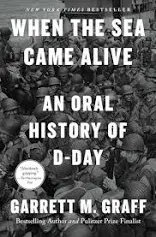
When the Sea Came Alive: An Oral History of D-Day, by Garrett M. Graff. 3.5 out of 4 stars. A gripping non-fiction account of the Normandy landings in which the author reads from selected and compiled first-hand accounts (essentially letters, bulletins and the like from decdes ago). I'm usually skeptical of "oral history" books, but this one was educational and inspirational. It focuses on the initial landing and the soldiers' bravery therein. It helped me understand a moment in history I've read about many times before in different ways. Perfect for a road trip to Flagstaff! The best part of this book is how it puts you right inside those ships alongside those soldiers ... you are landing at Normandy Beach and you have to get out of the ship. Do you know why you're here and what your particular assignment is?

The Only Plane in the Sky: An Oral History of 9/11, by Garrett M. Graff. 3 out of 4 stars. After I read the book about D-Day, I decided to try the same author, but I hesitated to start this due to its potential trauma-inflicting content, but the book was not as hard to read as I had anticipated. The stories and content reminded me of those same days in my life around 9/11 and revealed new angles I hadn't considered. It's fascinating to read the history of an event I lived through, offering a glimpse into how future historians might capture our experiences. Ultimately of these two Graff books, the one on D-Day is better -- something about his way of grouping the content and the letters/accounts helped me understand that event beyond the content of the letters and such. With the 9/11 book, I was deeply moved and engaged, but it didn't feel like the author's arrangement of the accounts did enough for me to justify having a whole new book about 9/11. Another way of saying this I suppose is that it felt like a lot of the ground in the 9/11 book had already been covered for me in different essays, books, films, and other media I have consumed over the past 25 years.

Comments