Top 10 or 11 World Cup Moments as Spain Defeats Argentina in a Historic Final

The 2026 FIFA World Cup did not need a single defining scene. It had three host nations, expanded stakes, packed stadiums across North America, and a final that felt like a meeting of football generations. Still, one image rose above the rest: Spain lifting the trophy after beating Argentina in a historic final. Duh. Or maybe the single defining image was idiot Trump begging FIFA to overturn the red card against the American striker.
This Top 10 or 11 list ranks the tournament’s biggest moments by impact, drama, and how strongly they shaped the story fans will tell for years. The order gives extra weight to matches and performances that changed the mood of the competition, not just the scoreline.

10. The three-nation World Cup made the tournament feel bigger from day one
The 2026 World Cup was always going to stand apart because of its scale. Staged across the USA, Mexico, and Canada, it gave the tournament a different rhythm. Long travel, varied climates, and distinct football cultures became part of the story. Many citizens in the USA enjoyed having so many foreign tourists discover charming elements of the USA, like ranch dressing and well-stocked grocery stores.
Mexico brought deep World Cup history and noise as well as some of the top uniforms in the context. Their home matches in Mexico City had epic crowd noise and vigor. The United States brought huge venues and a sense of spectacle. Canada gave the tournament a fresh northern edge, with cities eager to prove they belonged on the biggest stage, along with fresh excitement for a Canada underdog.
The result was a competition that felt less centered on one host identity and more like a continental celebration. That mattered because the expanded field needed room to breathe. Smaller nations had more chances to create memories, while traditional powers had less room to sleepwalk through early matches. Importantly, focus was somewhat shifted away from the USA with its giant economy and too substantial global presence generally.
The setting also helped frame Spain’s victory. This was not a title won in familiar European conditions. Spain had to adapt across time zones, stadium styles, and opponents who treated every match like a final.
9. The expanded field gave underdogs more space to matter
A larger World Cup always brings debate. Some worry it weakens the group stage. Several teams in this world cup appeared completely inept at times. Others see the expanded group as a door opening for nations that rarely get this stage.
In 2026, the expanded field helped create one of the tournament’s core themes: football depth is spreading. Teams outside the usual elite arrived with better organization, braver pressing, and players hardened by elite football leagues around the world.
The most memorable underdog performances were not only about shock results. They were about games where favorites had to solve real problems:
Low blocks that forced patience.
Fast wide players who punished lazy defending.
Goalkeepers who turned narrow defeats into national pride.
Midfields that refused to be overwhelmed by famous shirts.
That made the knockout rounds feel earned. Spain, Argentina, and the other contenders did not simply pass through ceremony. They were tested early, and that sharpened the pressure around every giant.
8. Young stars announced the next era
Every World Cup introduces new faces, but 2026 felt especially symbolic. Many of the sport’s great veterans such as Messi and Ronaldo were either nearing the end of their international careers or carrying a final version of their national story.
That gave younger players a brighter spotlight.
Spain’s young attackers and midfielders became central to its run. Their confidence stood out, not only in flashes, but in decision-making. They pressed without fear, received the ball in tight spaces, and treated major knockout matches like club games they had been playing for years.
For Argentina, the tournament carried a different tension. The world watched to see how the champions of the previous era would blend experience with renewal. Argentina found strength in that mix, using veteran calm and younger legs to reach the final.
This is one reason the final felt so rich. It was not just Spain against Argentina. It was one football cycle meeting another.

7. The group stage reminded everyone that style only matters under pressure
Spain’s reputation has long been tied to the ball. The passing, the angles, the patience, the idea that control can become a form of defense. They passed the ball with speed and brilliance, at times looking like they were playing against less experienced defenders.
At this World Cup, the question was whether Spain could add enough edge to that identity. Beautiful possession means little if it leads to sterile matches and slow exits. The 2026 team answered with more bite.
Spain’s best group-stage moments came when possession had purpose. The center backs stepped into midfield. The fullbacks offered width at the right time. The front line pressed in waves, then attacked before opponents could reset.
That balance made Spain more dangerous than some past versions. The team could still pause a match and pass teams into fatigue, but it also had runners willing to attack open grass. That mix carried through the tournament and became vital in the final against Argentina.
6. Argentina’s route to the final showed champion DNA
Argentina did not reach the final by accident. The team still carried the habits of a champion side: emotional control, clever fouls when needed, and a belief that close matches belonged to them.
Their run had the familiar Argentine texture. There were tense spells, fierce defensive stands, and sudden moments of attacking clarity. Even when opponents disrupted their rhythm, Argentina rarely looked confused. They knew how to suffer.
That ability made them the perfect final opponent for Spain. Argentina could press, drop deep, counter, and turn a loose ball into chaos. Spain’s passing game had to deal not only with technical pressure, but with emotional pressure.
The final gained weight because Argentina arrived with credibility. Beating them meant more than winning one match. Spain had to take the trophy from a team that understood how to protect one. Even though Argentina did not play its best in the final, no one doubted that Argentina was the correct team to be in the final against Spain.
5. The semifinal stage gave the tournament its sharpest tension
The best World Cups often tighten in the semifinals. The early romance fades. The margins shrink. Coaches get cautious, players feel the weight, and one mistake can erase a month of work.
In 2026, the semifinals gave the final its emotional runway. Spain’s semifinal performance confirmed that its football could survive the deepest phase of the tournament. The team did not abandon its best ideas. It trusted them.
Argentina’s semifinal had a different feel. Their match leaned more on nerve, experience, and moments of control amid pressure. They made the final because they understood tournament football as much as they played it.
Together, those semifinal stories created a clean contrast:
Spain played like a team building momentum through the ball.
Spain leaned into speed, spacing, and pressing.
Spain looked like the future arriving early.
Argentina played like a team using experience to manage danger.
Argentina leaned into timing, duels, and emotional control.
Argentina looked like a champion refusing to fade.
That contrast made the final feel inevitable once the last whistle blew in the semifinals.
4. The final became a tactical duel before it became a classic
Spain versus Argentina had all the ingredients of a grand final, but what made it special was how much thought sat behind the drama.
Spain wanted the ball, but not aimless possession. The midfield tried to attract pressure, then release runners into the spaces Argentina left behind. Spain’s wide players stretched the field, forcing Argentina’s fullbacks into difficult choices.
Argentina tried to interrupt that rhythm. They pressed in bursts, then dropped into compact lines. Their forwards looked for quick transitions as soon as Spain lost the ball. The idea was clear: do not let Spain settle into comfort.
The first big moments came from that friction. Spain carved out chances through sharp movement around the box. Argentina answered with direct attacks that forced Spain’s defenders to defend space, not just players.
Key players shaped the tone:
Spain’s midfield leaders gave the team patience when the final threatened to become frantic.
Spain’s wide attackers forced Argentina to defend the full width of the pitch.
Argentina’s goalkeeper and back line kept the match alive during Spain’s strongest spells.
Argentina’s creative players turned broken plays into real danger.
The match did not feel won by luck. It felt solved, piece by piece.
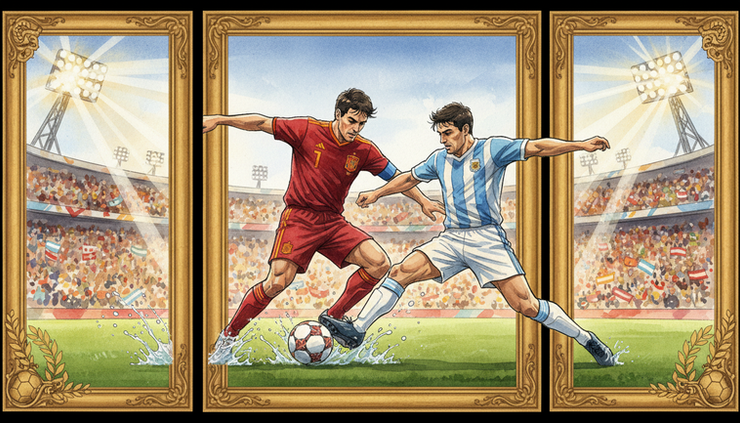
3. Spain’s key final stretch turned control into a trophy
The defining phase of the final came when Spain turned possession into pressure that Argentina could no longer fully escape.
Spain’s passing did three things well in that stretch:
It moved Argentina side to side until gaps appeared.
It pulled midfield markers out of position.
It gave Spain’s attackers the timing to arrive facing goal.
That is where the match tilted. Spain did not need constant chaos. They needed repeatable pressure. Each attack forced Argentina to make another clearance, another recovery run, another decision under stress.
Argentina still had moments. A final against Argentina is rarely calm. They threatened through quick counters and set pieces, and Spain needed concentration from its center backs and goalkeeper to stay ahead of the danger.
But Spain’s best players looked clear-headed. They did not rush low-value shots. They recycled the ball when needed. They attacked when the gap was real. That discipline made the difference.
For fans of football, soccer, World Cup 2026, FIFA history, this final will likely stand as a match where style and ruthlessness met at the right time.
2. Standout players gave the tournament its human story
Great tournaments live through players, not brackets. The 2026 World Cup had plenty of names who shaped the emotional arc.
Spain’s title run centered on a balanced core. The midfield gave the team identity. The wide players gave it threat. The defenders gave it the platform to keep playing bravely under pressure.
Three Spanish traits stood out:
Composure in midfield
Spain kept trusting short passes even when opponents pressed hard.
Directness in wide areas
The team avoided possession for possession’s sake. When the wing was open, Spain used it.
Collective defending after losing the ball
Spain’s press after turnovers stopped opponents from turning defense into attack.
Argentina’s standout players gave the final its resistance. Their defenders absorbed long spells. Their midfield fought for second balls. Their attackers kept Spain honest until the end.
The contrast made the final more memorable. Spain did not beat a flat opponent. It beat a proud, dangerous Argentina side that forced every idea to be tested.
That is how legacies form. Not through easy wins, but through wins that reveal what a team truly is.
1. Spain beating Argentina in the final became the tournament’s lasting image
Spain’s victory over Argentina will define the 2026 World Cup because it carried meaning beyond the result.
It marked a new high point for Spanish football. After the golden era that peaked with the 2010 World Cup and European success around it, Spain spent years searching for the next version of itself. The country still produced technique, midfield control, and elite club talent, but international dominance is never automatic.
This win showed that Spain did more than remember an old identity. It updated it.
The 2026 champions played with the familiar Spanish love of the ball, but they added pace, pressing, and sharper attacking choices. They looked less like a team trying to recreate the past and more like one using the past as a foundation.
The impact could be huge:
Spain’s youth development model gains another global badge of proof.
Young Spanish players get a new national standard to chase.
The senior team enters the next cycle with belief, not nostalgia.
Spanish football strengthens its claim as both a technical and competitive force.
For Argentina, the loss does not erase the strength of their tournament. Reaching the final again kept them at the heart of the world game. But Spain’s win changed the ending. The champions were not only the better team on the night. They became the team that gave the tournament its final meaning.
Spain’s 2026 triumph will be remembered as the moment a great football nation stopped looking back and started defining its next era.

Why Spain’s 2026 win shapes the tournament’s legacy
The 2026 World Cup will be remembered for its scale, its geography, and its expanded field. It showed how global the sport has become and how many nations can now make elite teams uncomfortable.
But tournaments need a champion that fits the story. Spain fit this one perfectly.
A World Cup spread across the USA, Mexico, and Canada needed a winner able to handle change. Spain did. An expanded tournament needed a champion that proved quality could still rise above complexity. Spain did. A final against Argentina needed nerve, imagination, and control. Spain had all three.
The legacy of 2026 is not only that Spain won. It is that Spain won in a way that connected generations. The echoes of the past were there in the passing and patience. The future showed up in the speed, pressure, and bravery of younger players.
That made the final more than a trophy match. It became the clearest statement of the tournament: football keeps changing, but the best teams are the ones that carry their identity forward without becoming trapped by it. Spain did that, and the 2026 World Cup will carry their name because of it.


Comments